Seesaw
Zaid Arshad
Shimabuku
TJ Shin
29 Ability Plaza, Arbutus Street
London, United Kingdom
23 January - 28 February 2025
The exhibition, Seesaw, acts as a cross-section compartment providing space for the coming-togethers and splittings of practices which investigate these same transactions of material and the contextual positioning of use-value.
The cross section is made literal between the vertical gallery window and its thin descending blinds and the lateral, heavy vectors of the gallery’s shelves which visually extend and match to the Overground Line at Haggerston Station visible through the window.
The mechanisms along the continuums of input/output and action/reaction and their “/“ cruxes are presented from different angles: historically through Arshad’s collected objects, personally and experientially through Shimabuku’s scaled actions, and systematically through Shin’s “black boxes” that indifferently sort through inputs.
One thing that seems to emerge across all of the artworks’ functions is the nuanced self-consciousness arrived at after passing over or through them. At what point is this other thing directly relating to your individual presence? Where is that presence positioned between the bounds of that work? And what is its position in relation to others in the internal facing space of the gallery?
According to Pierre Francastel, ‘Art and mathematics are the two poles of any logic thinking—the major thinking modes of humanity.’ In fact, since Greek Antiquity, art and mathematics have always nurtured a natural dialogue, forming together a tissue of opposed polarities, fruitful tensions and partial osmoses. Concepts, symbols and materials often separate the artist and the mathematician, but a common strategy—to think and imagine through dialectic, relational webs—brings them together. For Francastel, ‘As the mathematician … combines schemes of representation and prediction where the real is associated with the imaginary, so the artist confronts elements of representation with other imagination issues. In both cases, the dynamism of a thought that becomes aware of itself by expressing itself and materializing itself in ‘signes-relais’ [’relay-signs’] extends and encompasses elements of experience and those of the logic of the mind.’ The transits between reality and imagination, the Many and the One, the particular and the universal, the local and the global, constitute the very core of mathematical and artistic creativity. If their signes-relais are often different (and, in some cases, the specificity of mathematical signes-relais preclude the possibilities the artist has of entering into the realm of mathematics), the underlying relational protogeometry which governs the intertwining of the different signs can be extremely close.”1
(1) Fernando Zalamea, Multilayered Sites and Dynamic Logics for Transits between Art and Mathematics, Glass Bead, 2016.
![]()
Drawing by Charles Sanders Peirce (The Peirce Papers, Harvard University)
***
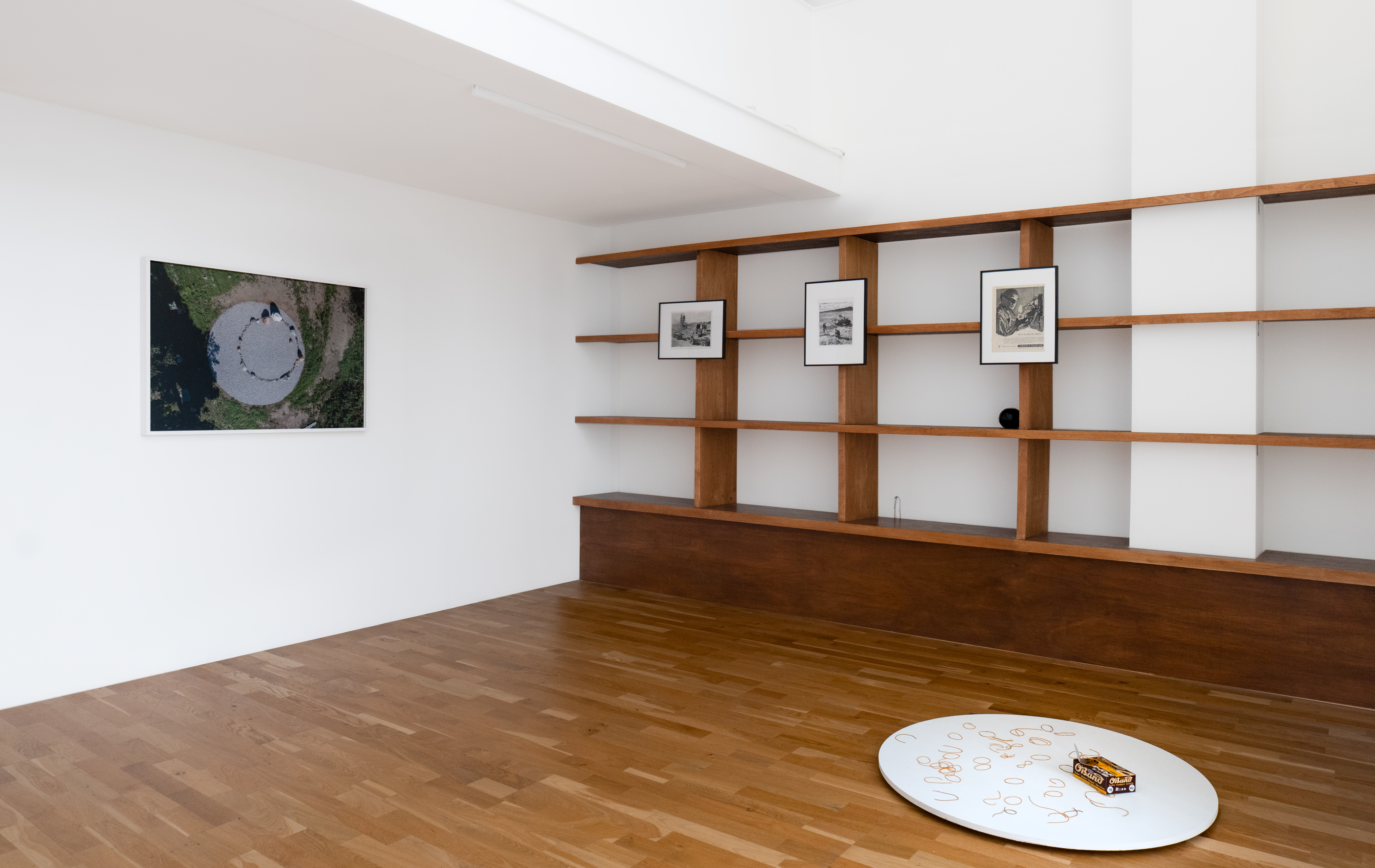
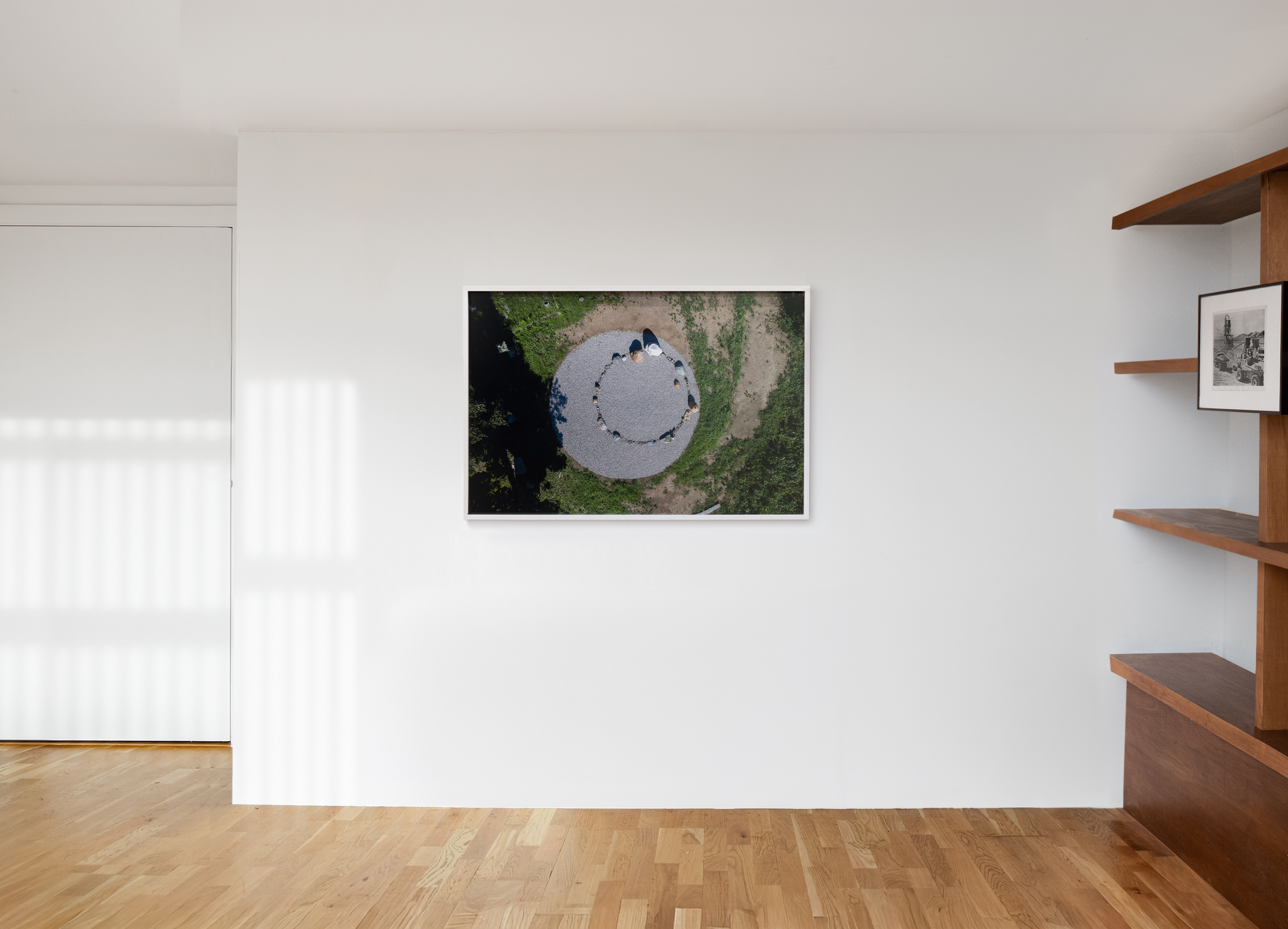
Shimabuku’s Passing Through the Rubber Band immediately sets forth two tests: whether or not to follow the instructions and participate and whether or not your body will pass through the band without snapping. The second part is produced by self-consciousness along with the evident successes and failures of previous participants. The work gives it former attempts as evidence of effort along with the artist’s other work on display, Necklace: Carrying Stones up the Mountain, a photograph of a work of land art by the artist, acts an upscaled image and result of an action eclipsing the form of the discarded (collected?) rubber bands.
Speaking about Necklace, the artist explains, “The Kunisaki Peninsula, which protrudes into the sea like a parabolic antenna, has historically been a destination for a variety of cultures and objects arriving from all quarters. I thought of this as I carried stones from Okinawa and Setouchi across the sea, from Hokkaido, and used them to create a circle on top of the mountain: a necklace dedicated to Mt. Gion. My hope is that as people come here, as people climb the mountain, the number of stones will grow and the necklace will flourish, becoming ever-living.”
Both actions fulfil their function in being simultaneously in progress in the hands of others while being complete as the products of the artist’s initial action and experience. They essentially provide an unending possibility of variety to Shimabuku’s implied initial experience.
***
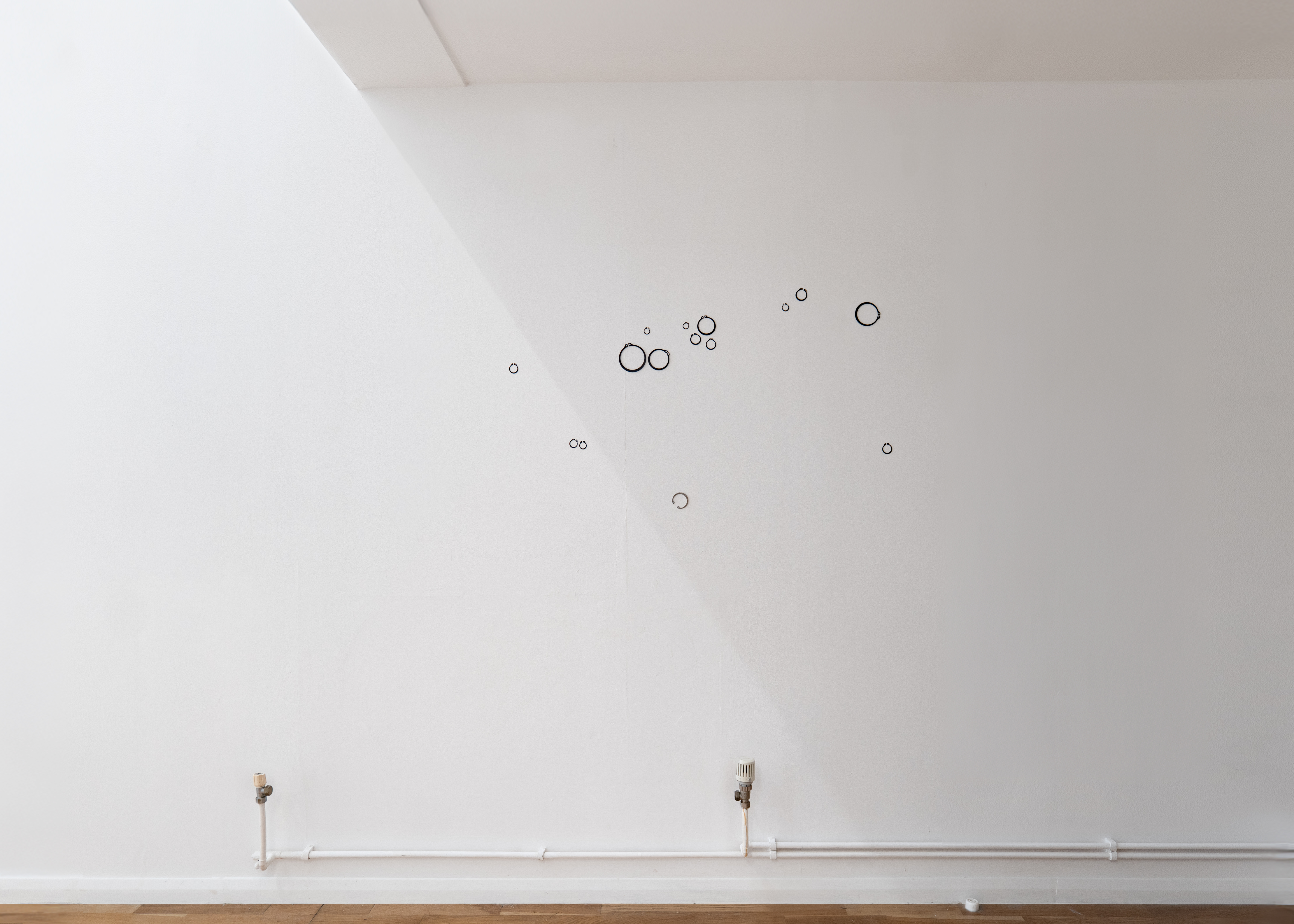
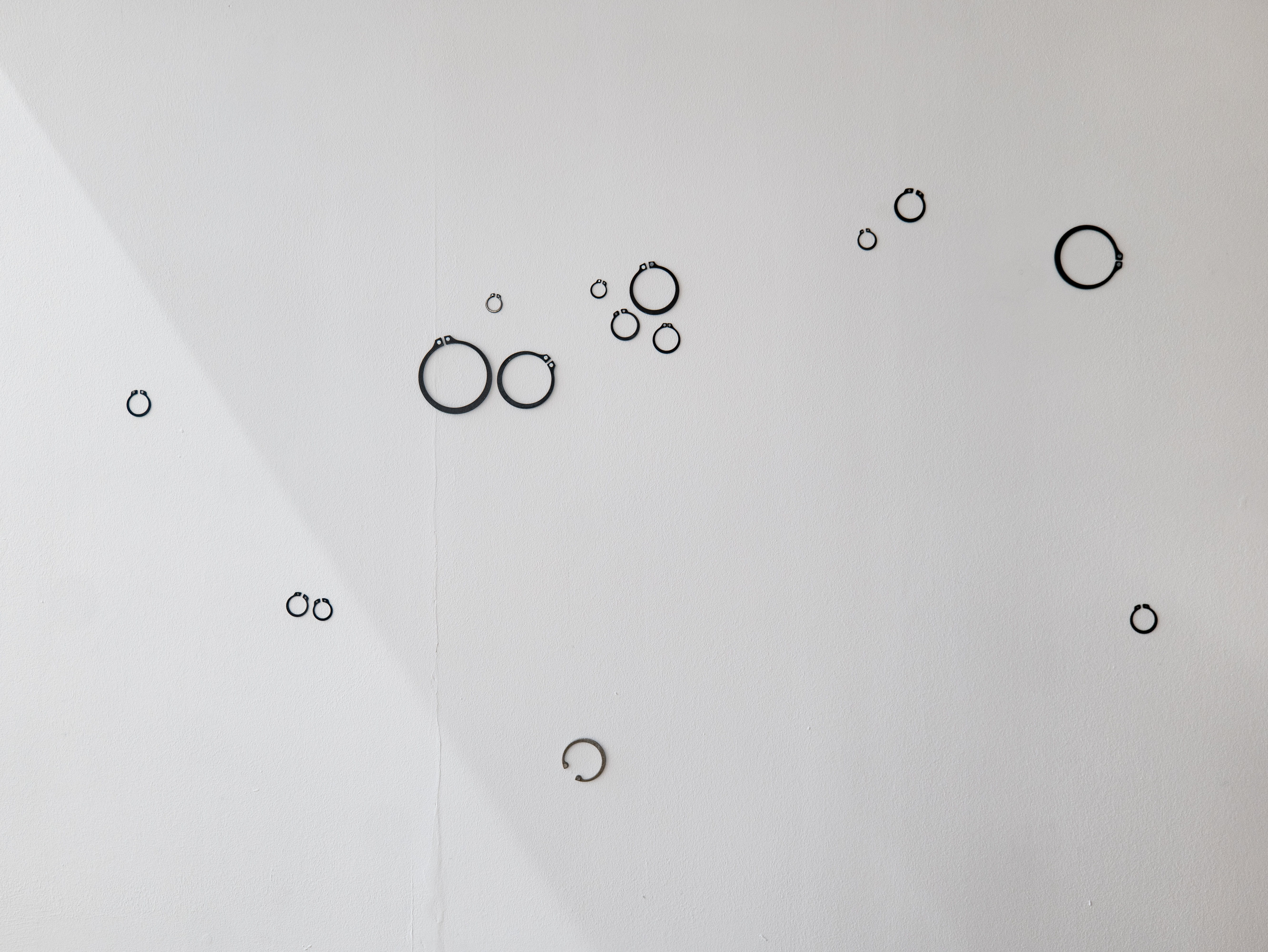
On the gallery’s main floor, Zaid Arshad’s historical presentations of collected documents and objects present a nuanced map of relations between humanity and their multiplicity of actions - in this case regarding the value, extraction, and use of phosphorus. The evidence displayed is pointed in its specificity to source and circumstance, but purposefully passive at the consideration of its whole range. For example, two silver gelatin prints from 1955 and 1970 capture images of militarised extraction of phosphorous. Adjacent to these two reportage photographs is All in the dark, a 1951 newspaper advertisement for phosphorous matches. Across the gallery, Model refers back to phosphorous extraction operations around the world in its composition made of retaining rings.
Each grouping or artwork is encountered in situations in which possible propagandistic, narrative, or moralistic structures are slightly derailed into one another. As their whole considerations are built up, the possible narrative structures exist as such but become more like points or attributes of a constellation, with this constellation and its own shape arriving more clearly into the mind’s eye.
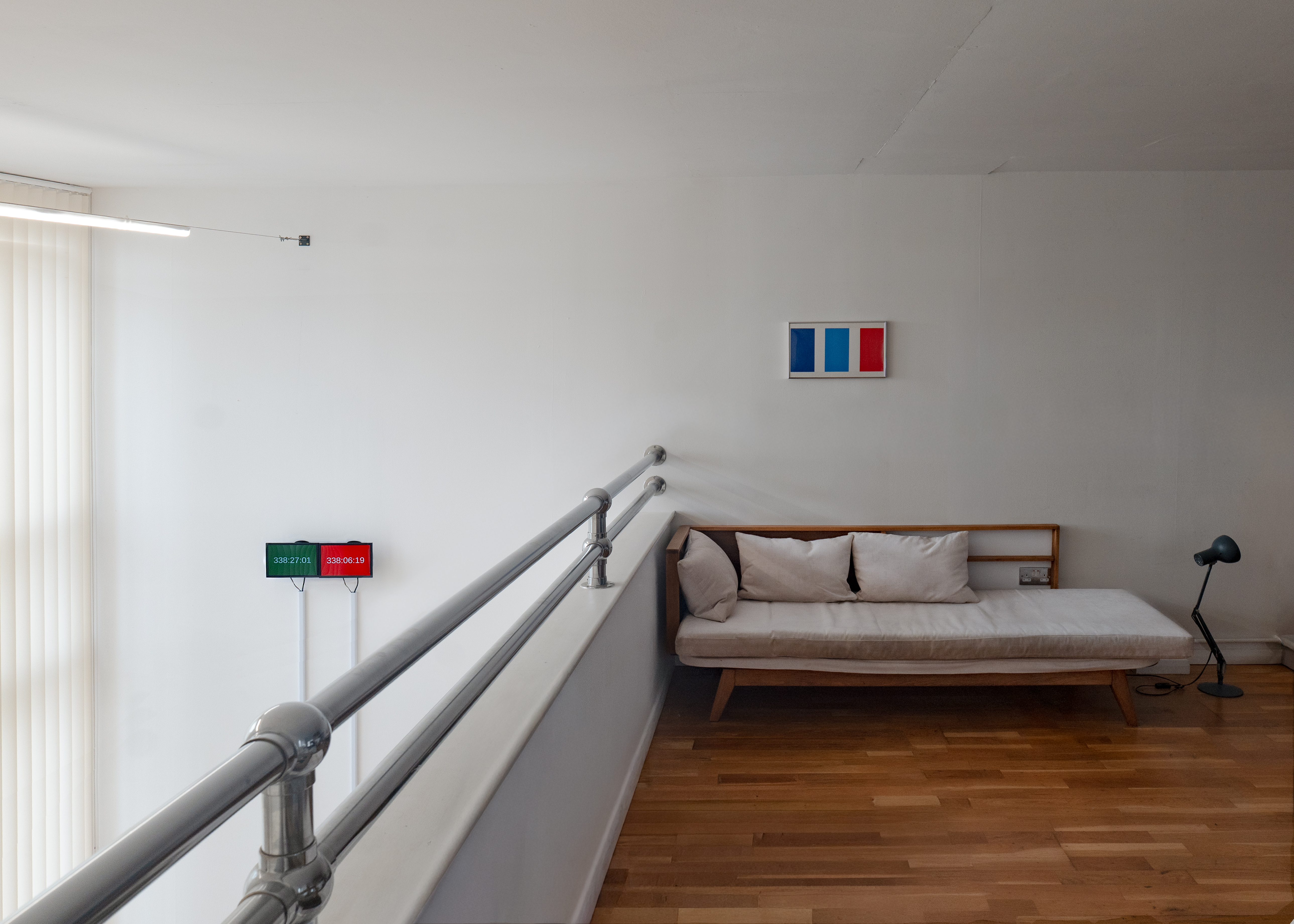
Above the rest of Seesaw, on the gallery’s mezzanine floor, hangs Arshad’s Minujusth (2017-2019), a screenprint on paper work referencing the colours and compositions of different ribbon designs for medals awarded by the UN for ‘peace missions’ carried out in Haiti between 1993 and 2019. The works from this series were carried out in collaboration with Josias de Gonaïves, a printmaker in Haiti.
***
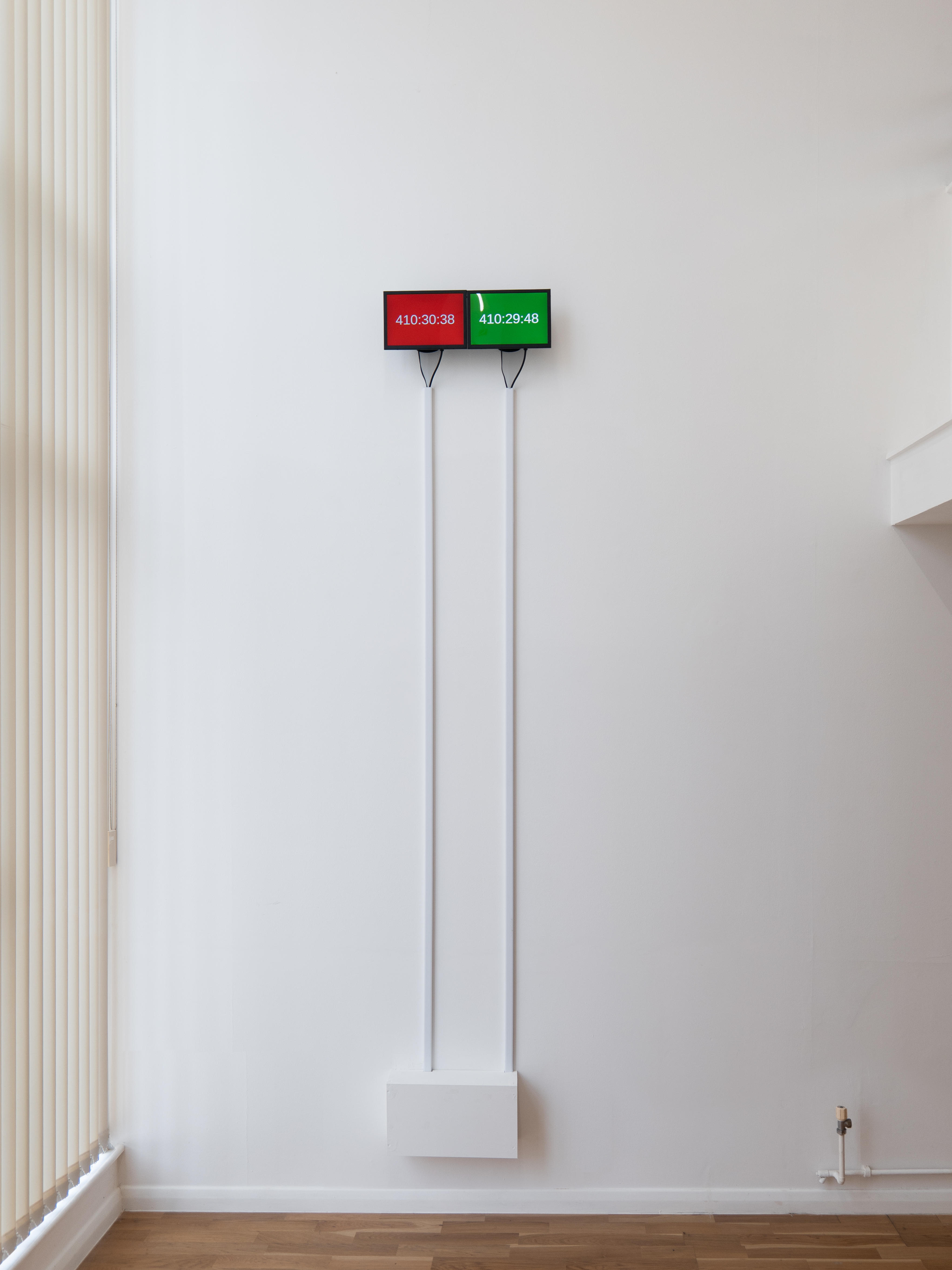
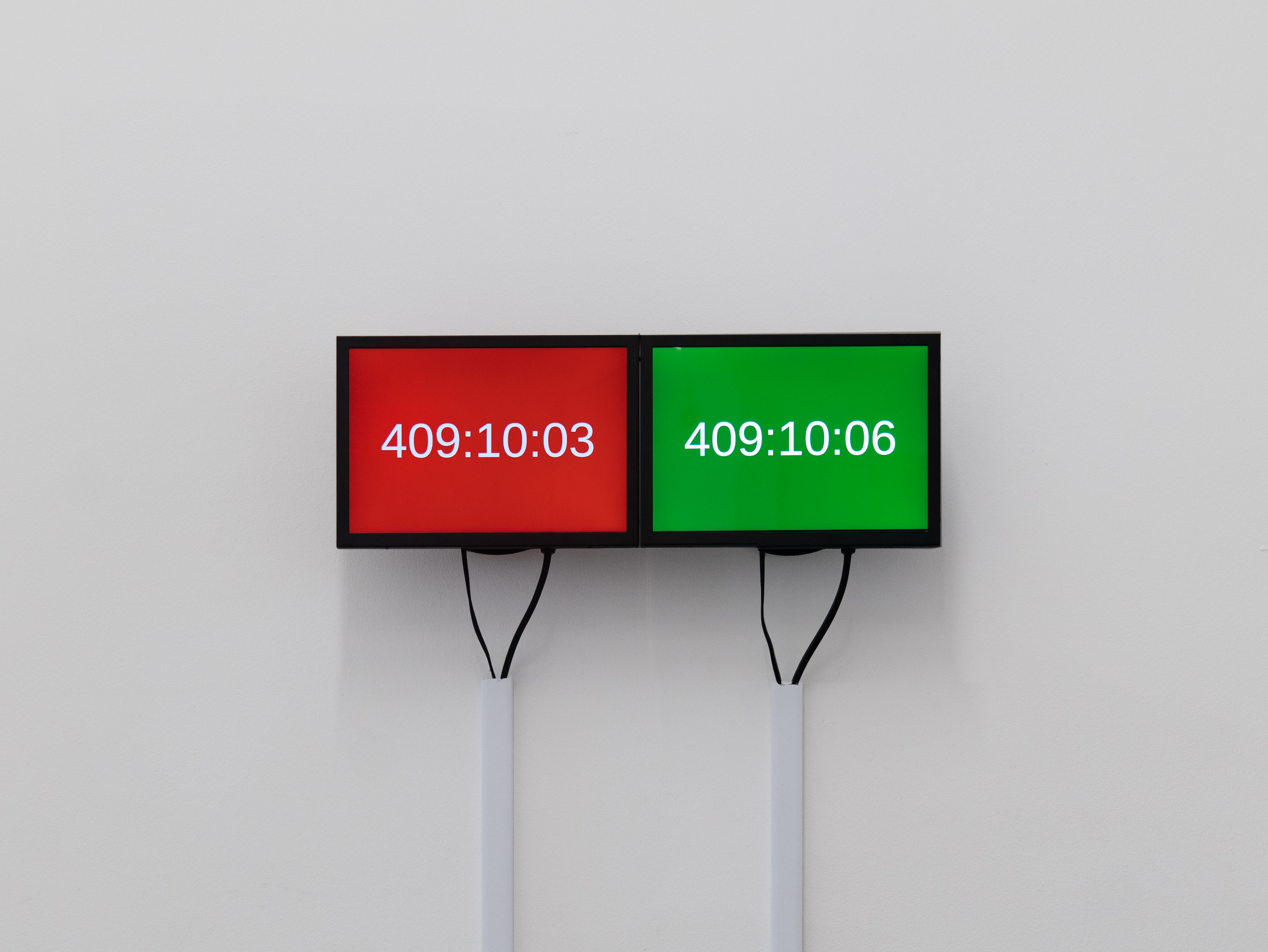
TJ Shin’s chess clock, See-Saw (the exhibition’s namesake) passively trades the remaining lifespan of the exhibition’s physical existence. Toweing over the gallery space, its vertical span mirrors the column on the opposite wall, where Shin’s 8 Ball can be found. Shin lists the mechanics of the clock as follows:
- Unless otherwise specified, the chess timer starts at 00:00:00, meaning the program must be launched at midnight on the exhibition opening date.
- The chess timer runs until both clocks reach 00:00:00. Once both timers reach 00:00:00, the two screens will flash red and green.
- The two clocks run alternately, never simultaneously, according to a uniform random distribuition, selecting intervals between 1 second and 1 minute. Every value within this range haas an equal probability of being selected. The system does not use quasi-random or weighted distribution.
- If one clock reaches 00:00:00 before the other, the clock with remaining time continues counting down until it reaches 00:00:00
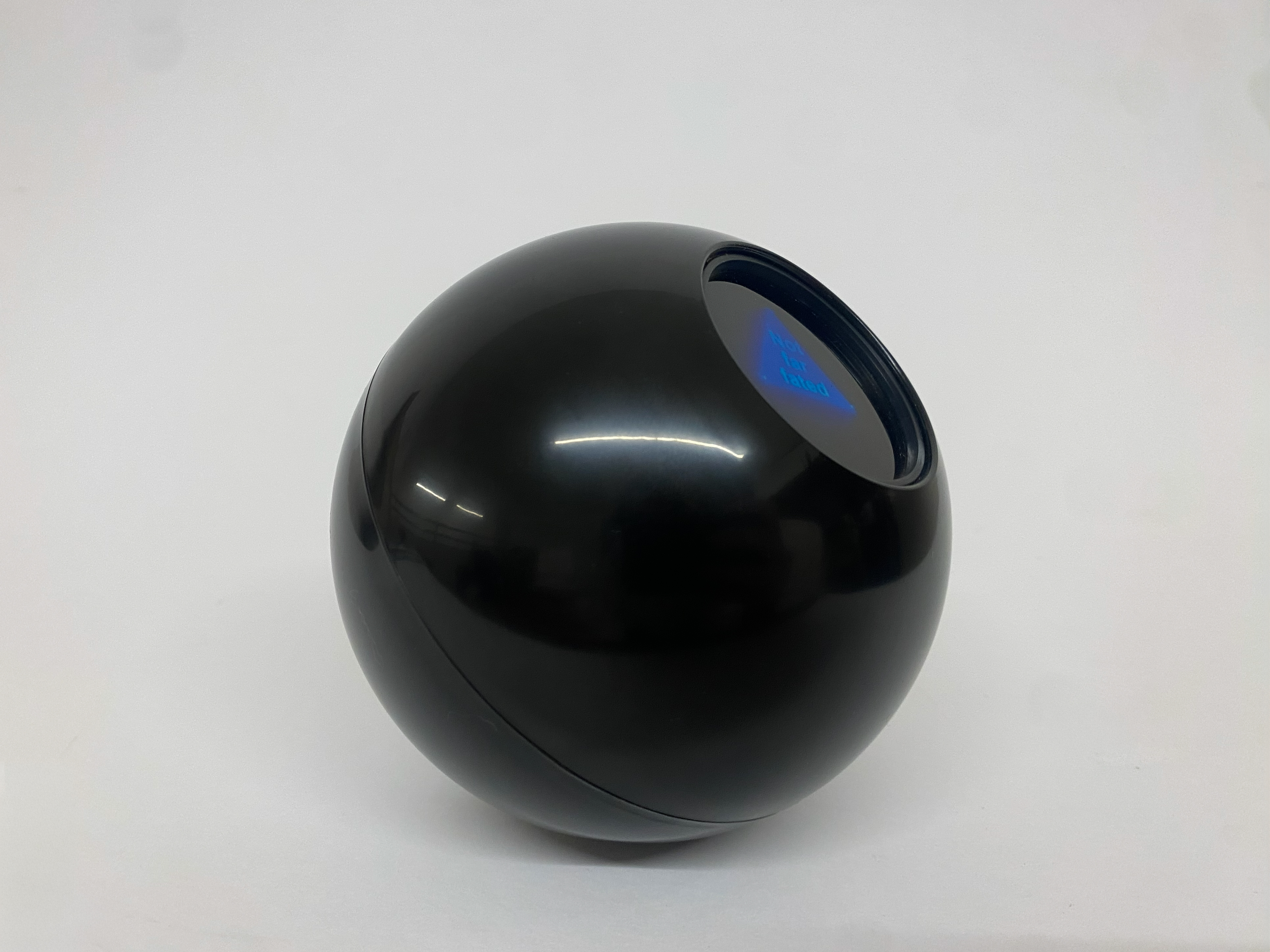
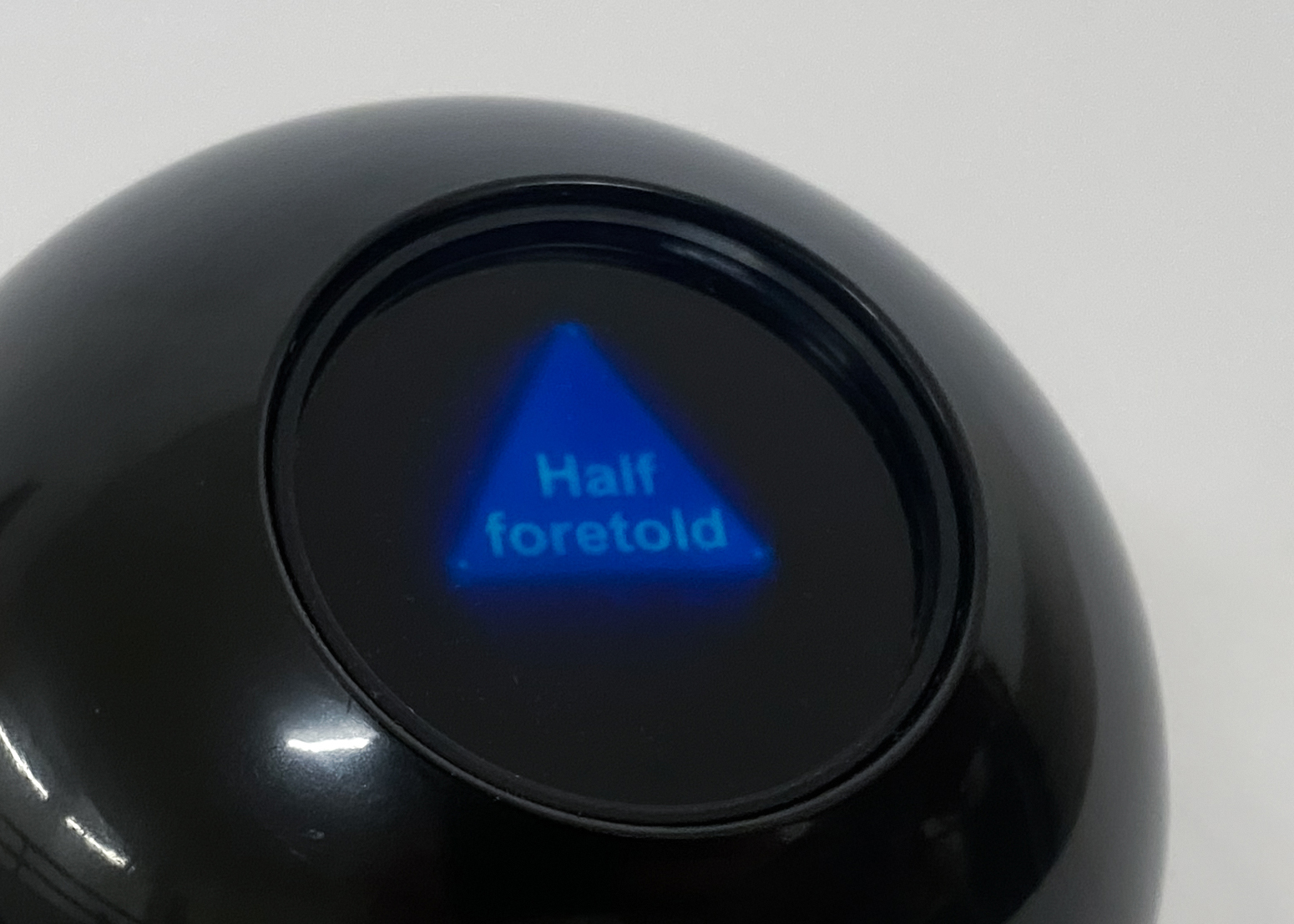
Operating along similar principals of bi-lateral randomness, TJ Shin’s 8 Ball, is a modified Magic 8 Ball, a novelty toy traditionally used for fortune-telling or seeking advice, reformatted by the artist to produce only ‘double conditional’ answers. The traditional ‘yes’ and ‘no’ answers are replaced with phrases such as ‘partially countered’, ‘scarcely unlucky’, ‘half foretold’ and ‘somwhat null’, producing indeterminate results which cancel eachother out and therefore become nullified, tracing an action of giving up agency and having it returned.
Zaid Arshad
Shimabuku
TJ Shin
29 Ability Plaza, Arbutus Street
London, United Kingdom
23 January - 28 February 2025
The exhibition, Seesaw, acts as a cross-section compartment providing space for the coming-togethers and splittings of practices which investigate these same transactions of material and the contextual positioning of use-value.
The cross section is made literal between the vertical gallery window and its thin descending blinds and the lateral, heavy vectors of the gallery’s shelves which visually extend and match to the Overground Line at Haggerston Station visible through the window.
The mechanisms along the continuums of input/output and action/reaction and their “/“ cruxes are presented from different angles: historically through Arshad’s collected objects, personally and experientially through Shimabuku’s scaled actions, and systematically through Shin’s “black boxes” that indifferently sort through inputs.
One thing that seems to emerge across all of the artworks’ functions is the nuanced self-consciousness arrived at after passing over or through them. At what point is this other thing directly relating to your individual presence? Where is that presence positioned between the bounds of that work? And what is its position in relation to others in the internal facing space of the gallery?
According to Pierre Francastel, ‘Art and mathematics are the two poles of any logic thinking—the major thinking modes of humanity.’ In fact, since Greek Antiquity, art and mathematics have always nurtured a natural dialogue, forming together a tissue of opposed polarities, fruitful tensions and partial osmoses. Concepts, symbols and materials often separate the artist and the mathematician, but a common strategy—to think and imagine through dialectic, relational webs—brings them together. For Francastel, ‘As the mathematician … combines schemes of representation and prediction where the real is associated with the imaginary, so the artist confronts elements of representation with other imagination issues. In both cases, the dynamism of a thought that becomes aware of itself by expressing itself and materializing itself in ‘signes-relais’ [’relay-signs’] extends and encompasses elements of experience and those of the logic of the mind.’ The transits between reality and imagination, the Many and the One, the particular and the universal, the local and the global, constitute the very core of mathematical and artistic creativity. If their signes-relais are often different (and, in some cases, the specificity of mathematical signes-relais preclude the possibilities the artist has of entering into the realm of mathematics), the underlying relational protogeometry which governs the intertwining of the different signs can be extremely close.”1
(1) Fernando Zalamea, Multilayered Sites and Dynamic Logics for Transits between Art and Mathematics, Glass Bead, 2016.
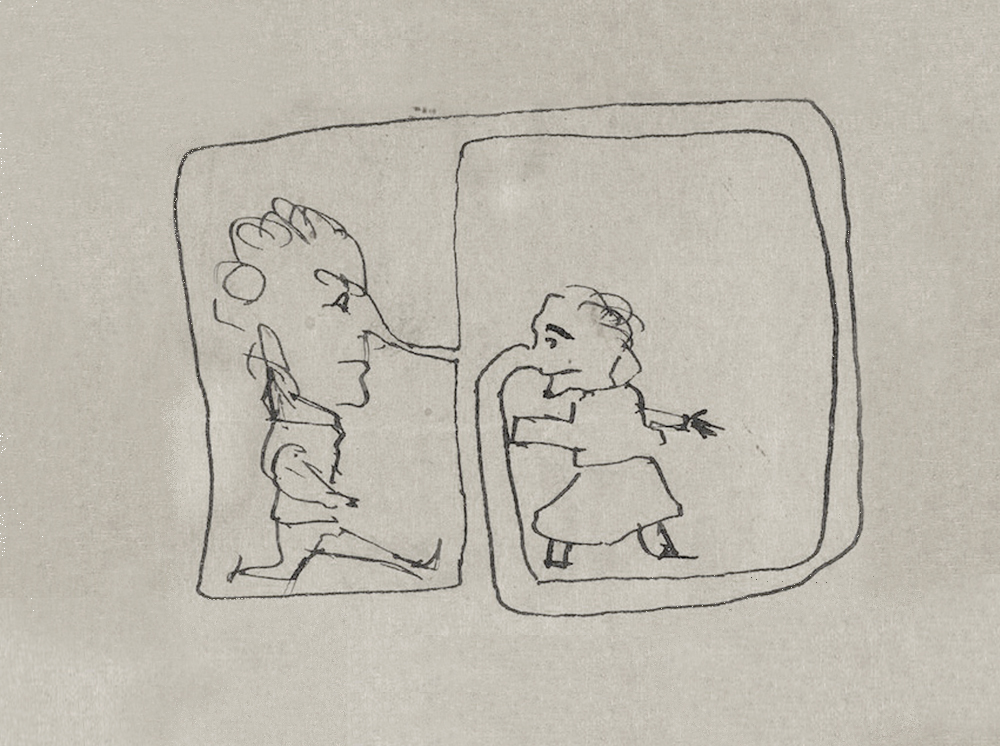
Drawing by Charles Sanders Peirce (The Peirce Papers, Harvard University)
***
Shimabuku’s Passing Through the Rubber Band immediately sets forth two tests: whether or not to follow the instructions and participate and whether or not your body will pass through the band without snapping. The second part is produced by self-consciousness along with the evident successes and failures of previous participants. The work gives it former attempts as evidence of effort along with the artist’s other work on display, Necklace: Carrying Stones up the Mountain, a photograph of a work of land art by the artist, acts an upscaled image and result of an action eclipsing the form of the discarded (collected?) rubber bands.
Speaking about Necklace, the artist explains, “The Kunisaki Peninsula, which protrudes into the sea like a parabolic antenna, has historically been a destination for a variety of cultures and objects arriving from all quarters. I thought of this as I carried stones from Okinawa and Setouchi across the sea, from Hokkaido, and used them to create a circle on top of the mountain: a necklace dedicated to Mt. Gion. My hope is that as people come here, as people climb the mountain, the number of stones will grow and the necklace will flourish, becoming ever-living.”
Both actions fulfil their function in being simultaneously in progress in the hands of others while being complete as the products of the artist’s initial action and experience. They essentially provide an unending possibility of variety to Shimabuku’s implied initial experience.
***
On the gallery’s main floor, Zaid Arshad’s historical presentations of collected documents and objects present a nuanced map of relations between humanity and their multiplicity of actions - in this case regarding the value, extraction, and use of phosphorus. The evidence displayed is pointed in its specificity to source and circumstance, but purposefully passive at the consideration of its whole range. For example, two silver gelatin prints from 1955 and 1970 capture images of militarised extraction of phosphorous. Adjacent to these two reportage photographs is All in the dark, a 1951 newspaper advertisement for phosphorous matches. Across the gallery, Model refers back to phosphorous extraction operations around the world in its composition made of retaining rings.
Each grouping or artwork is encountered in situations in which possible propagandistic, narrative, or moralistic structures are slightly derailed into one another. As their whole considerations are built up, the possible narrative structures exist as such but become more like points or attributes of a constellation, with this constellation and its own shape arriving more clearly into the mind’s eye.
Above the rest of Seesaw, on the gallery’s mezzanine floor, hangs Arshad’s Minujusth (2017-2019), a screenprint on paper work referencing the colours and compositions of different ribbon designs for medals awarded by the UN for ‘peace missions’ carried out in Haiti between 1993 and 2019. The works from this series were carried out in collaboration with Josias de Gonaïves, a printmaker in Haiti.
***
TJ Shin’s chess clock, See-Saw (the exhibition’s namesake) passively trades the remaining lifespan of the exhibition’s physical existence. Toweing over the gallery space, its vertical span mirrors the column on the opposite wall, where Shin’s 8 Ball can be found. Shin lists the mechanics of the clock as follows:
- Unless otherwise specified, the chess timer starts at 00:00:00, meaning the program must be launched at midnight on the exhibition opening date.
- The chess timer runs until both clocks reach 00:00:00. Once both timers reach 00:00:00, the two screens will flash red and green.
- The two clocks run alternately, never simultaneously, according to a uniform random distribuition, selecting intervals between 1 second and 1 minute. Every value within this range haas an equal probability of being selected. The system does not use quasi-random or weighted distribution.
- If one clock reaches 00:00:00 before the other, the clock with remaining time continues counting down until it reaches 00:00:00
Operating along similar principals of bi-lateral randomness, TJ Shin’s 8 Ball, is a modified Magic 8 Ball, a novelty toy traditionally used for fortune-telling or seeking advice, reformatted by the artist to produce only ‘double conditional’ answers. The traditional ‘yes’ and ‘no’ answers are replaced with phrases such as ‘partially countered’, ‘scarcely unlucky’, ‘half foretold’ and ‘somwhat null’, producing indeterminate results which cancel eachother out and therefore become nullified, tracing an action of giving up agency and having it returned.
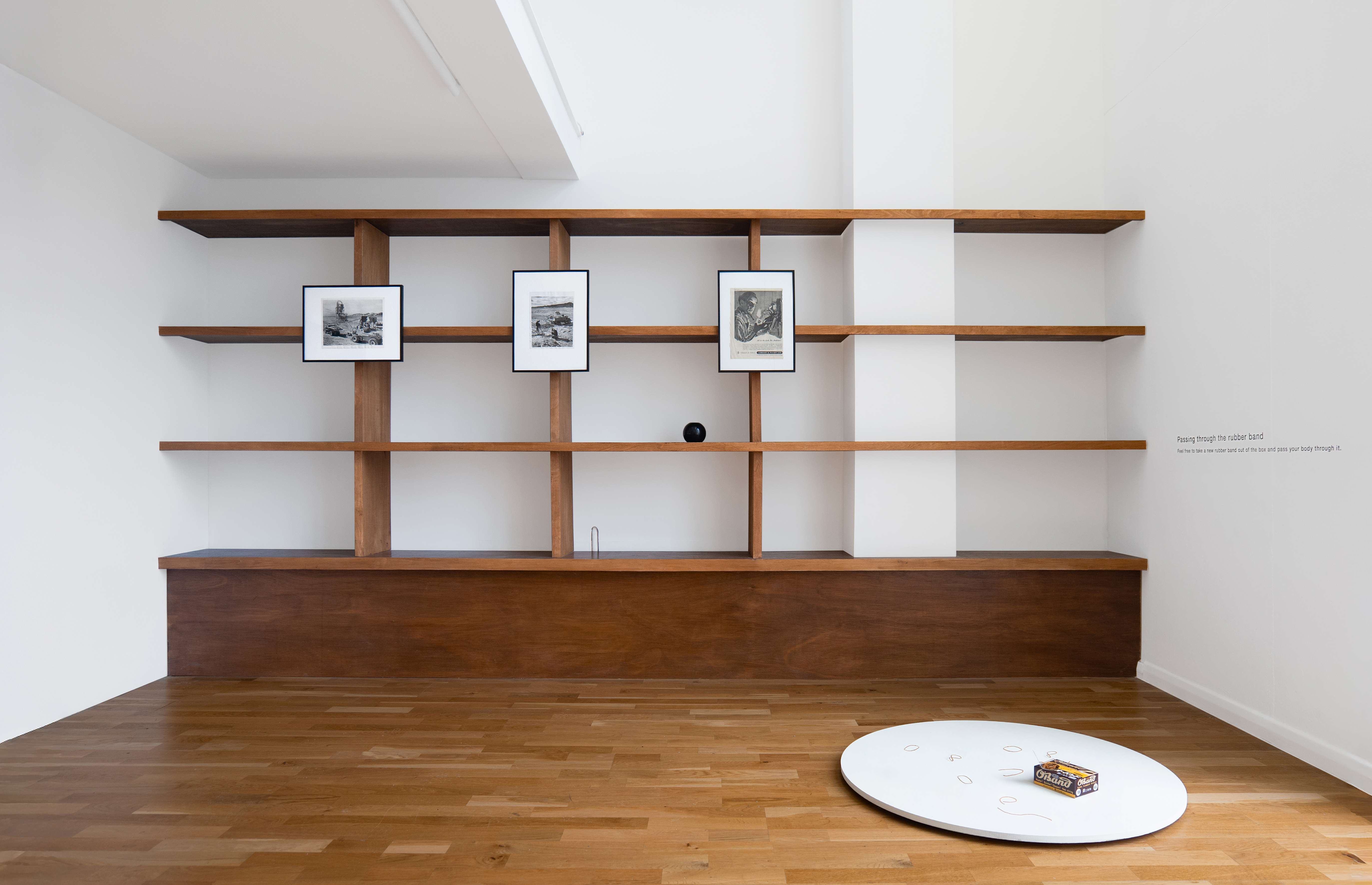
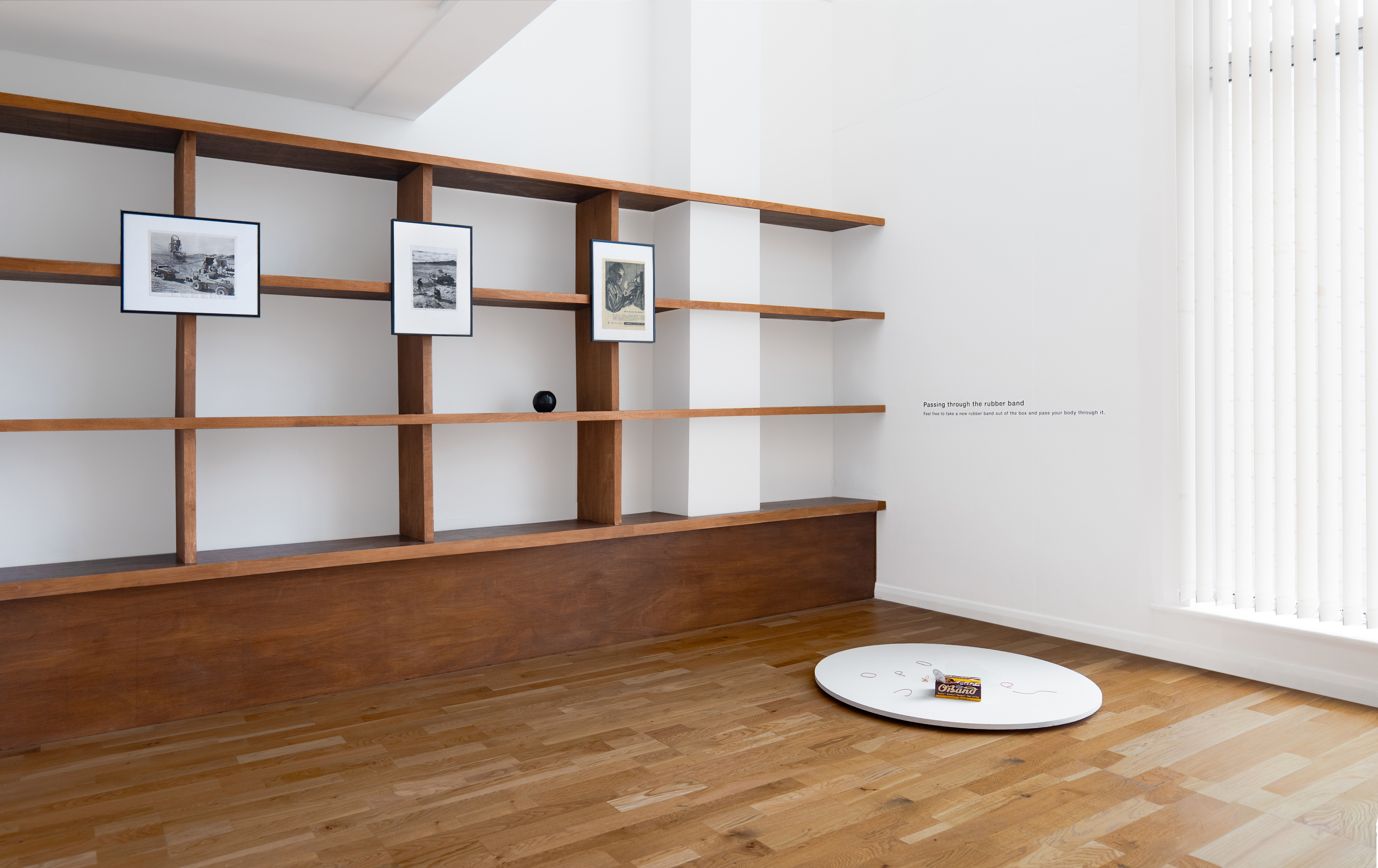
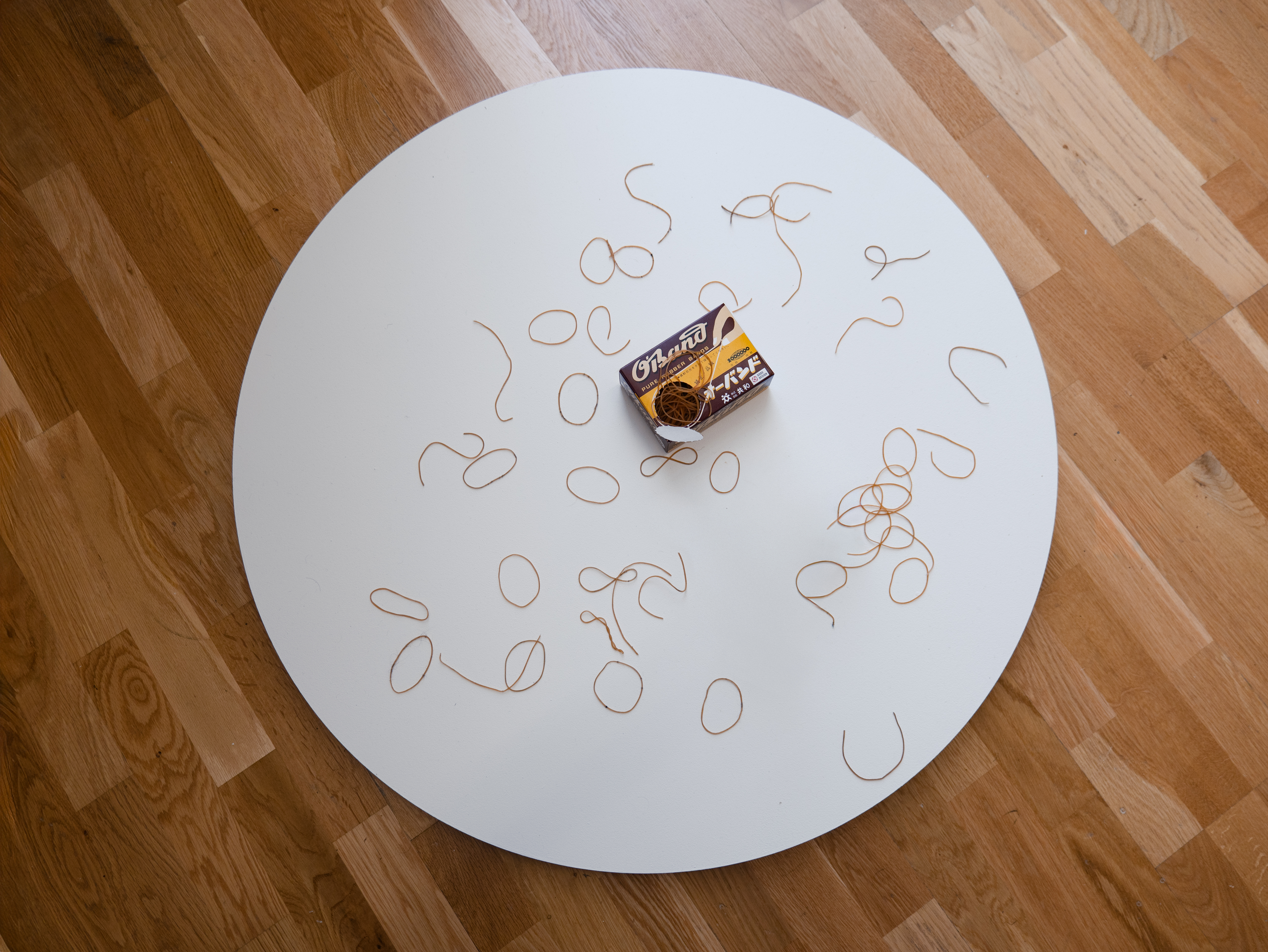
Shimabuku
Passing through the Rubber Band, 2000
Circular wooden platform, boxes, rubber bands, vinyl instructions
90 cm diameter
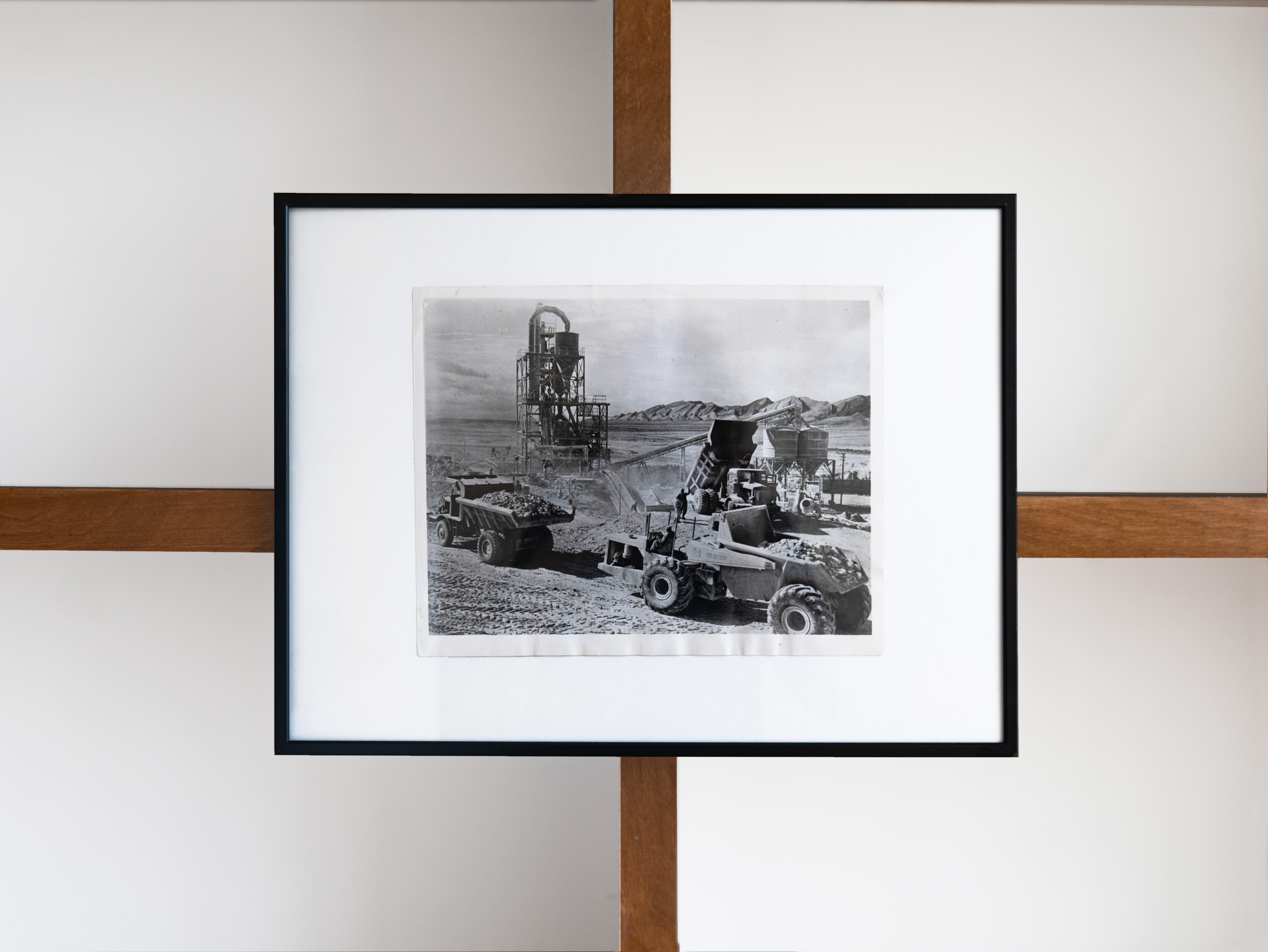
Zaid Arshad
Food is a weapon (Miners at Kurnub in The Occupied Naqab Desert) II, 1970/2025
Gelatin silver print, framed
30 x 40 cm
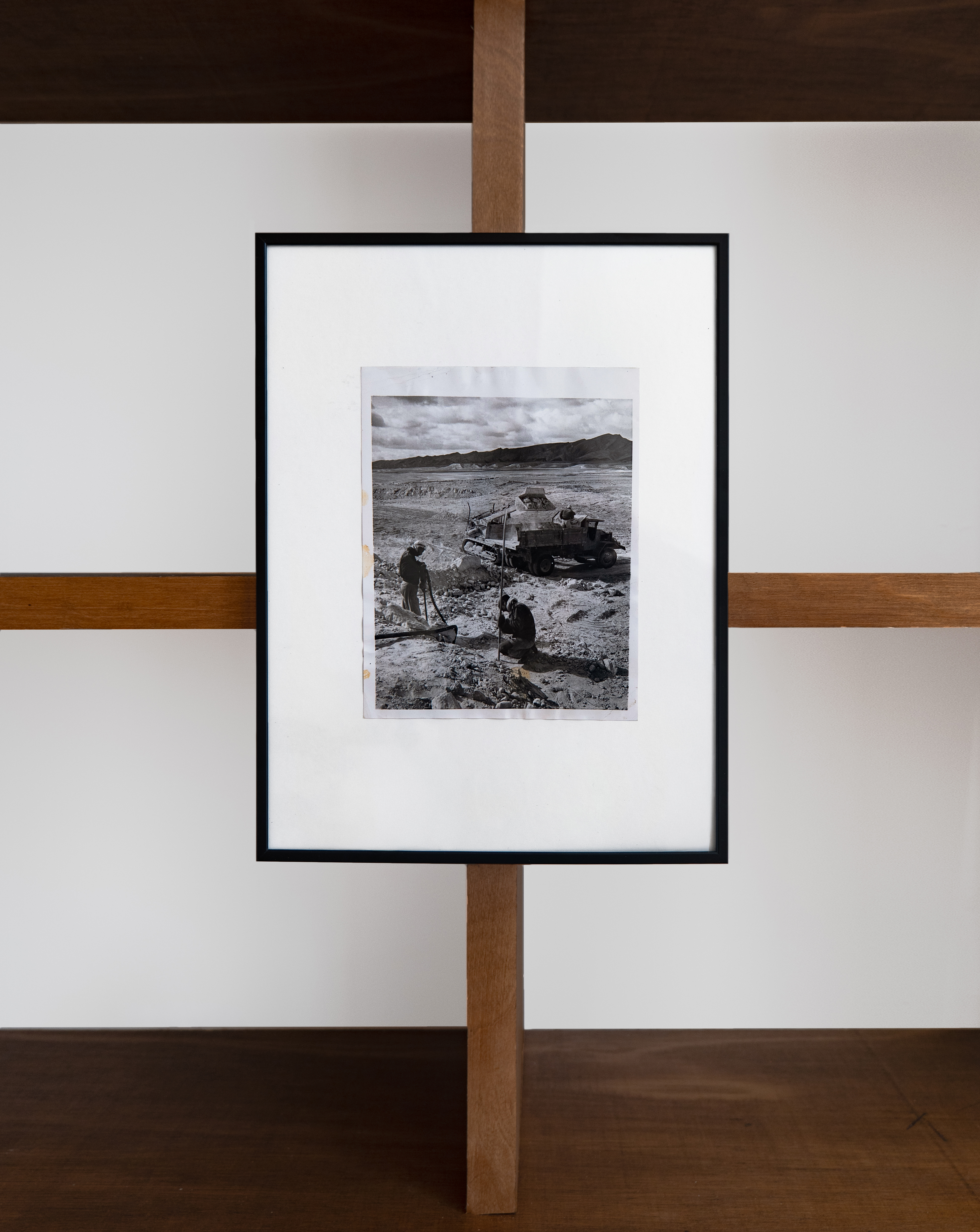
Zaid Arshad
Food is a weapon (Miners at Kurnub in the occupied Naqab Desert) I, 1955/2025
Gelatin silver print, framed
40 x 30 cm
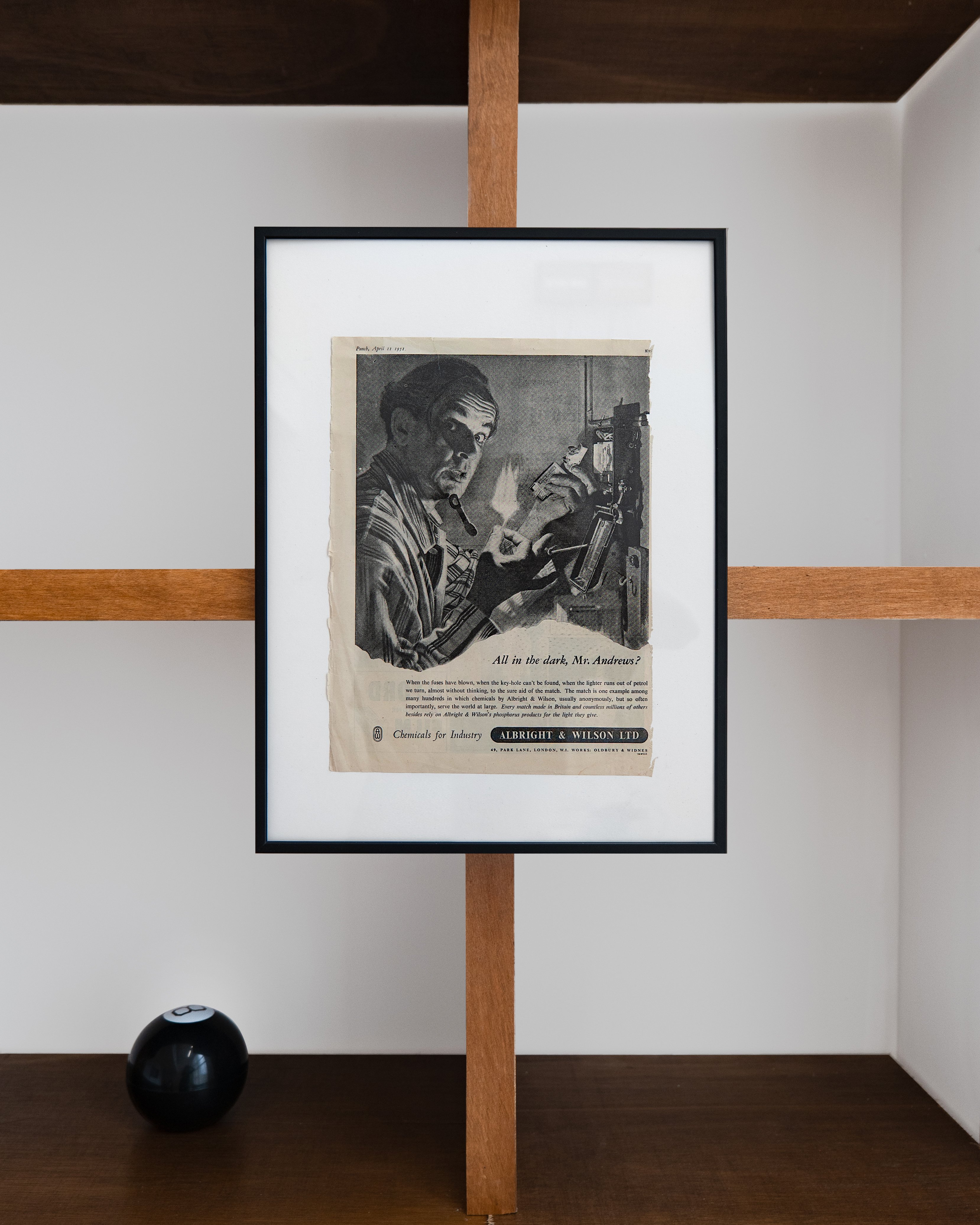
Zaid Arshad
All in the dark, 1951/2025
Print on newsprint, framed
40 x 30 cm
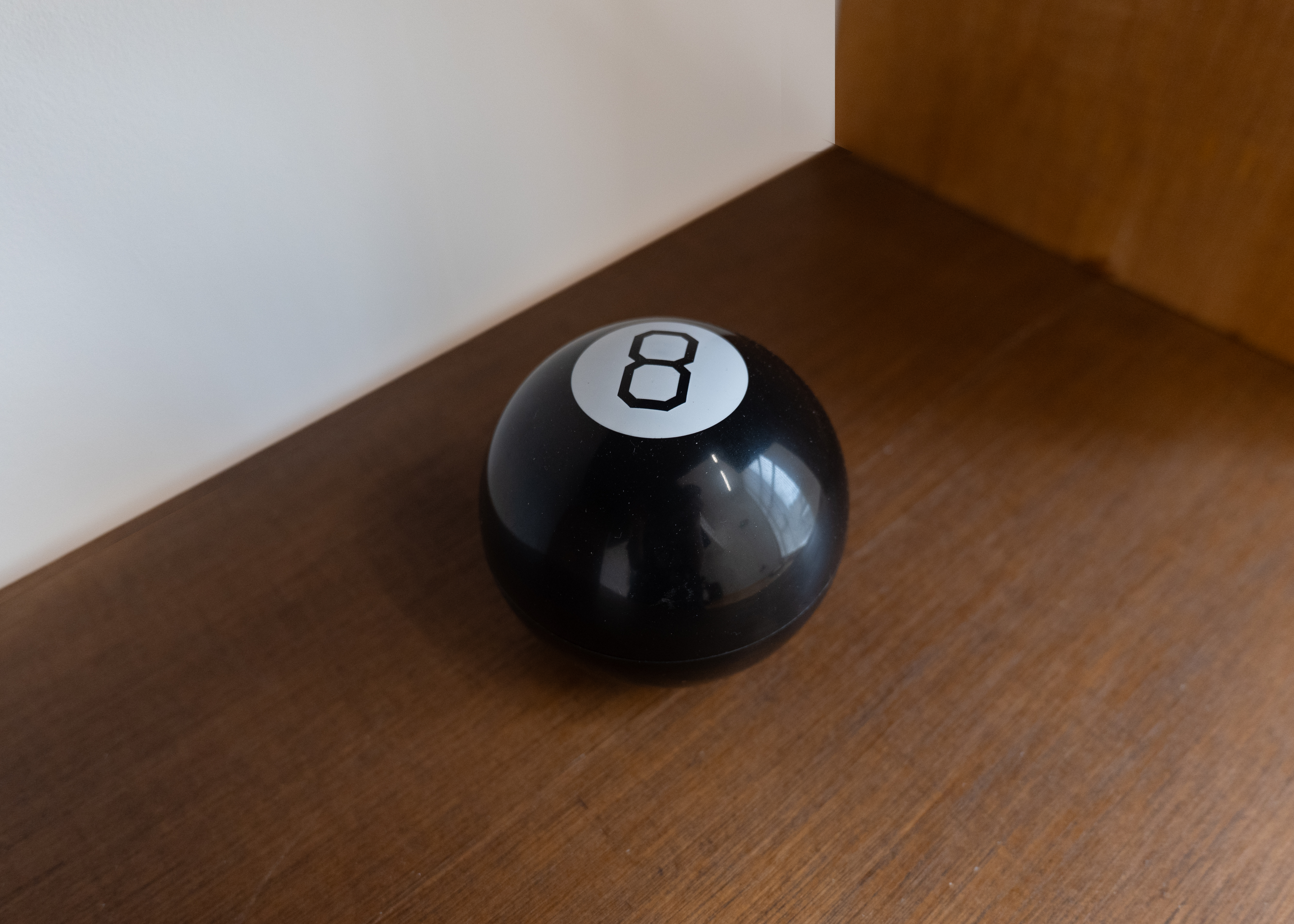
TJ Shin
8 Ball, 2026
Cast resin, liquid suspension, icosahedral die
10.2 x 10.2 x 10.2 cm
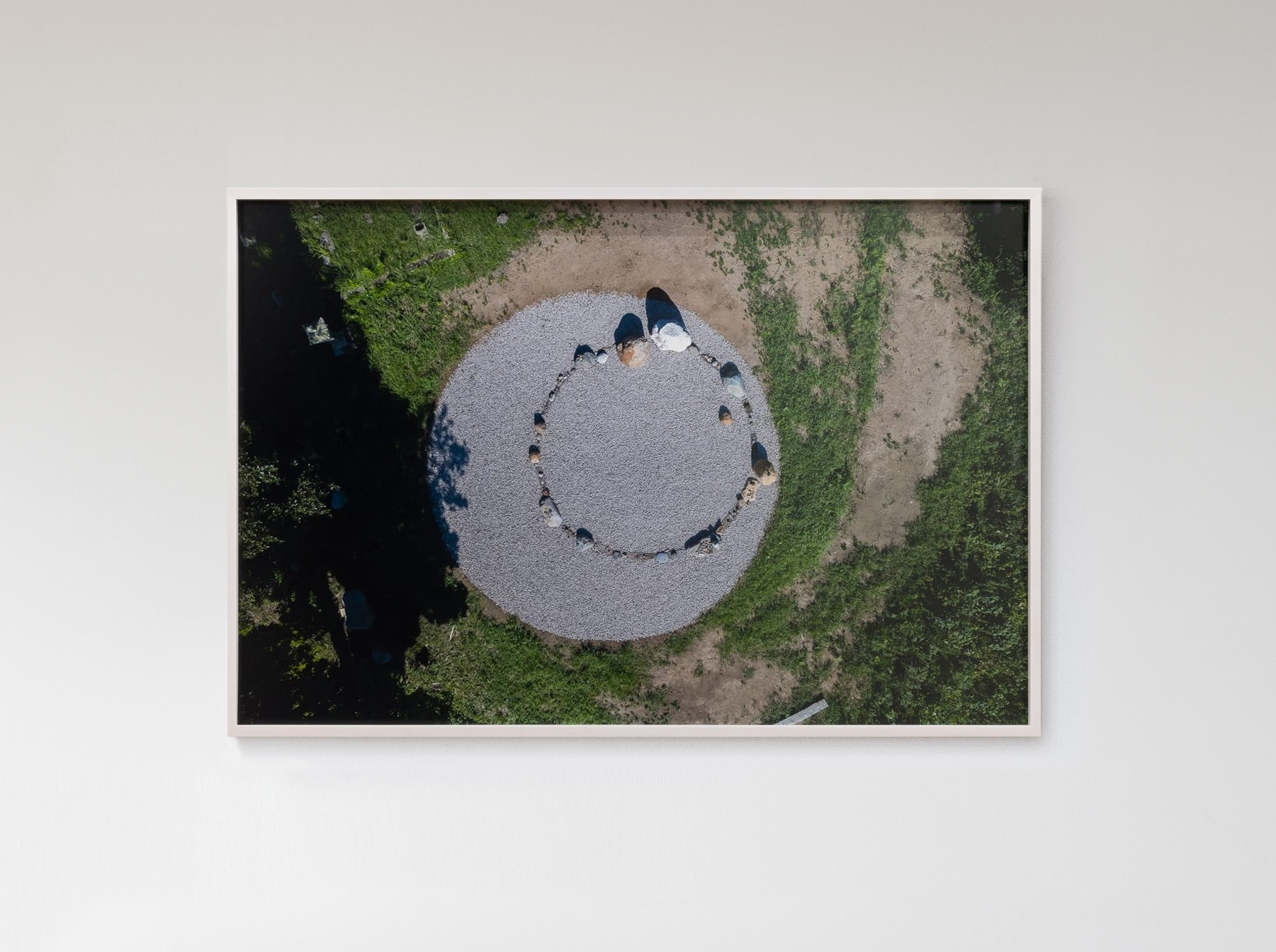
Shimabuku
Necklace: Carring Stones up the Mountain, 2021
Digital inkjet print on Hahnemühle photo rag (308 g/m2), mounted on aluminium, framed
70 x 105 cm
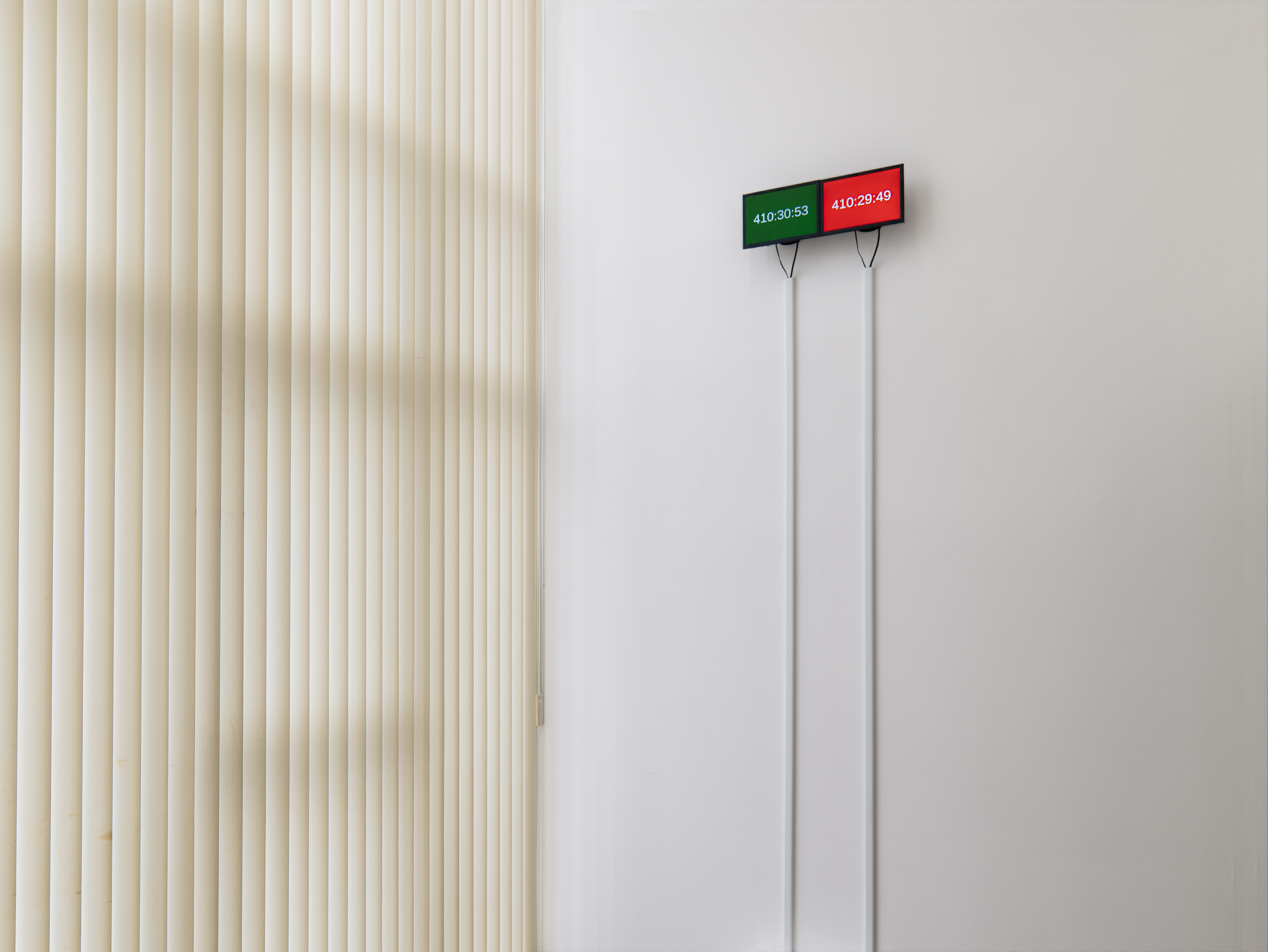
TJ Shin
See-Saw, 2026
Two-channel video, monitors, raspberry pi, hardware
300 x 42 x 20 cm
Duration variable
Zaid Arshad
Model, 2026
Steel retaining rings with phosphate finish, hardware
58 x 106 cm

Zaid Arshad
Minujusth (2017-2019), 2025
Screenprint on paper, produced in collaboration with Josias de Gonaïves
27.5 x 44.5 cm